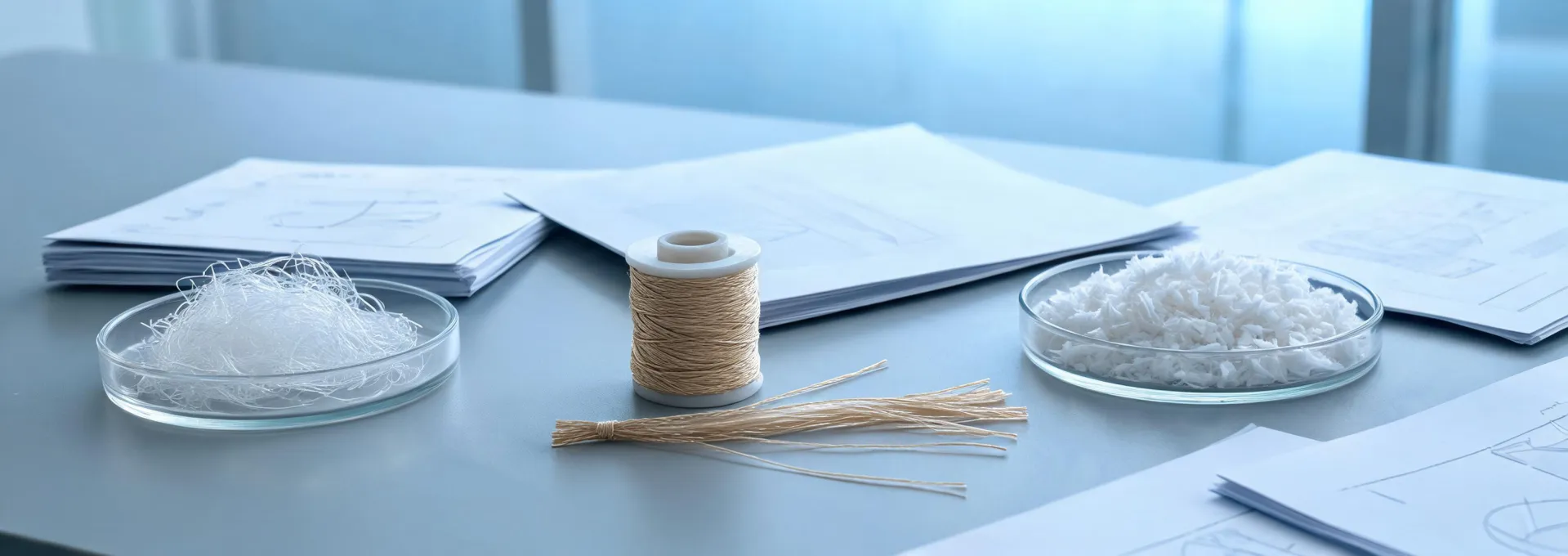
Kuraray fiber documents aligned with material specimens

Evidence review path

Kuraray product information without borrowed claims

This page explains how to frame a product-information review. It does not assert testing, sampling, approval, supply, inventory, or order-management services. The aim is narrower: identify the material, locate the applicable official evidence, and state what remains unknown.

Three distinct reviews

Do not collapse unlike fiber routes into one specification

P

PVA family identity

Begin with the official PVA fiber family and named grade. KURALON, water-soluble KURALON K-II, flame-retardant VINARL, and spun yarn carry different form and application boundaries. Record whether the question concerns reinforcement, paper or nonwoven conversion, rope or thread, a soluble processing route, or a flame-performance application. A family-level summary must not imply that every grade dissolves, resists flame, accepts dye, or carries the same mechanical profile.

V

VECTRAN construction context

VECTRAN is a liquid-crystal polymer fiber route with its own grade and converted-form evidence. A review should distinguish filament or yarn from rope, sling, cable tension member, webbing, outdoor textile, protective construction, or composite. Tenacity, modulus, moisture response, creep, abrasion, cut behavior, thermal exposure, and chemical exposure need the stated specimen and method. A fiber-property summary is not a finished-article safety rating.

S

Short-cut fiber variables

Polyester short-cut fiber information should identify resin family, fineness, cut length, surface treatment, and intended wet-laid or dry-laid process. Water dispersibility, sheet formation, thermal stability, acid exposure, filtration, specialty paper, or separator use cannot be inferred from the words “polyester fiber” alone. Product dimensions and treatment language belong to the exact current document rather than a generic catalog description.

Numbered review sequence

Move from identity to a bounded statement

01

Name the product

Capture the full product family, grade, physical form, and document title or publication state. “Kuraray fiber” is too broad for a technical conclusion.

02

Define conversion

Record fineness or denier, cut length or yarn construction, twist, weave or braid, and any matrix or sheet-forming process that changes the specimen.

03

Set exposure

Describe load direction, moisture, heat, chemicals, abrasion cycles, conditioning, intended life, and the actual finished article under consideration.

04

Align the method

Separate published typical information from acceptance criteria. A method number, specimen geometry, unit, conditioning state, and document revision are needed for comparison.

Boundary, not guarantee

Published values are not an unconditional purchasing specification

A current official product document may provide typical properties, applications, or material characteristics. Those statements remain tied to the named product and documented conditions. They do not establish suitability for every yarn construction, fabric, composite, color, environment, production date, or safety use. Where a page does not provide a value or method, this site leaves it unasserted rather than filling the gap with a generic industry number.

Prepare a precise question

Anchor the inquiry to a named grade

Include the source document, physical form, converted construction, intended application, exposure and requested test method. Do not include confidential production data in the first message.

  • Exact product family or grade
  • Fiber, filament, yarn or short-cut form
  • Construction and use environment
  • Method, unit and acceptance context
Please provide your name.
Please provide a valid email.
Please describe the application and evidence request.