Identity before attribute
Use the complete family or grade name and distinguish fiber, filament, yarn, short-cut fiber and converted construction.
A fiber-focused view of Kuraray
Kuraray Co., Ltd. is a diversified materials company. This site deliberately narrows the story to PVA fiber families, VECTRAN liquid-crystal polymer fiber, and polyester short-cut fibers. Activities outside these three reviewed routes are omitted rather than folded into a broad materials catalog.
Documented material lineage
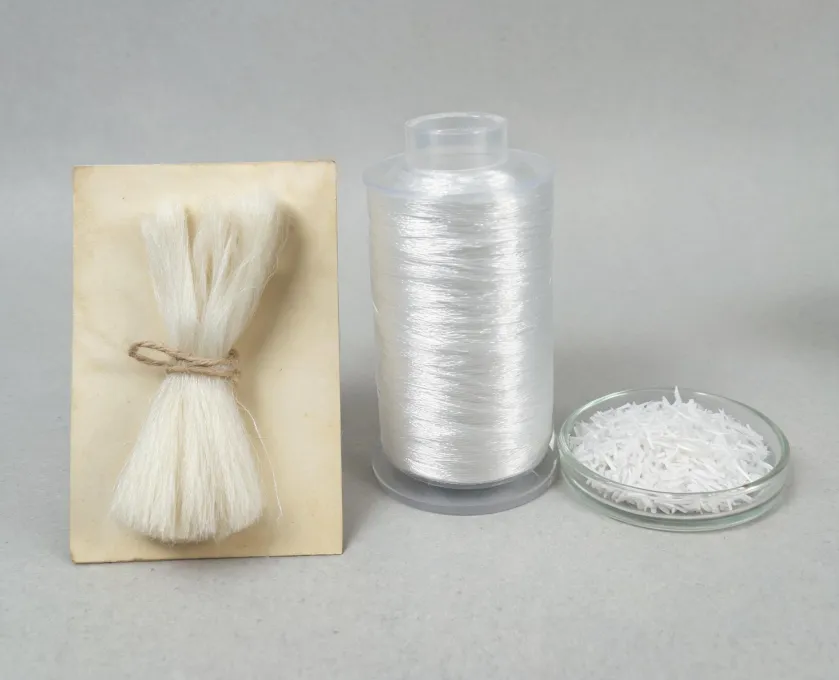
Kuraray’s official corporate history states that the company industrialized polyvinyl alcohol fiber in 1950 under the KURALON™ name. That milestone provides a precise historical anchor for the fiber story; it does not establish a present-day performance value for every grade. Current PVA fiber information separates KURALON, water-soluble KURALON K-II, flame-retardant VINARL, and spun-yarn forms, each with a product-specific application scope.
VECTRAN™ follows a different materials route. Kuraray’s official product information identifies it as a liquid-crystal polymer fiber and lists applications such as ropes, slings, webbing, cables, outdoor textiles, protective equipment and composites. Its published characteristics must be read with the exact grade, filament or yarn form, converted construction, environmental exposure, specimen and method. A general statement about the polymer fiber cannot substitute for a finished-article result.
Official product information also describes polyester short-cut fibers for wet-laid and dry-laid nonwovens, specialty paper, filters and related conversion routes. Here, fineness, cut length, surface treatment, dispersion and resin family are central review variables. The site does not assert standard ranges when the exact current product document has not been supplied.
CLARINO™ may be mentioned once here as Kuraray’s documented man-made-leather development. It is not listed in this site’s Yarns, Fibers and Threads catalog, SEO scope, or product cards.
Editorial values
Use the complete family or grade name and distinguish fiber, filament, yarn, short-cut fiber and converted construction.
Units, conditioning, specimen geometry and test method must align before two published values are treated as comparable.
No invented certificate, capacity, customer, factory, inventory, MOQ, lead time or universal performance fills a missing source.

Responsible information use
A procurement team may begin with an application such as cement reinforcement, a rope, a wet-laid filter, an outdoor textile, or protective equipment. The same application label can hide different fiber grades, constructions and test conditions. A responsible review turns the application into a set of explicit variables instead of treating a brand-level property list as a guarantee.
For PVA fiber, the distinction may involve reinforcement versus soluble processing or flame-performance use. For VECTRAN, it may involve filament grade, yarn construction, braid or weave, moisture, bending, heat, chemicals or impact. For polyester short-cut fibers, it may involve water dispersion, cut-length uniformity, treatment and sheet formation. These are decision inputs, not promises of supply or finished-product approval.
Keep the question bounded
Reference the official document and name the grade, form, construction and method you are evaluating.